

Author: Sean Mackay is the Curriculum Access Lead (old Literacy Coordinator) at Wigston Academy, Leicester. He has 21 years’ experience as an English teacher, but has also taught Media Studies, history and Maths. He spent 10 years as a Head of Year, leading Careers and PSHCE before moving to become the CAL. He changed the name of the role to move staff’s perception of Literacy being an “English thing” and students linking it to “primary stuff”. He is also the Literacy Lead for TELA, which is a network of Leicestershire schools coming together to help each other and share ideas about Literacy. You can find him on social media here:
X: @Seanteaching | Instagram: @LiteracyatWMAT | LinkedIn: @SeanMackay

When I first became a Literacy Coordinator, I was so excited. There were so many things that I wanted to do. By the end of the year every child in school was going to be a reader, parents were going to be totally involved in promoting literacy outside of school, all lessons would incorporate reading… the list of things that would happen was endless.
And so, with motivation, passion and a member of SLT behind me, I set the wheels in motion. Suffice to say, it all went terribly wrong and by the end of the year I was gutted, demotivated and ready to give up.
Thankfully, the SLT I had been assigned to was always ready to pick me up, to run with everything I wanted to do, to offer suggestions and to, at the end, push me past the defeat and to look at what I had learnt through the experience. Hopefully this is something I can also pass on to you in this little piece on something I tried to implement which didn’t go as planned.
The initiative in question was called ‘The Literacy Charter’, and this was followed up by also having reading in classrooms also added on to teachers’ performance management requirements (I know, I feel awful about it now).
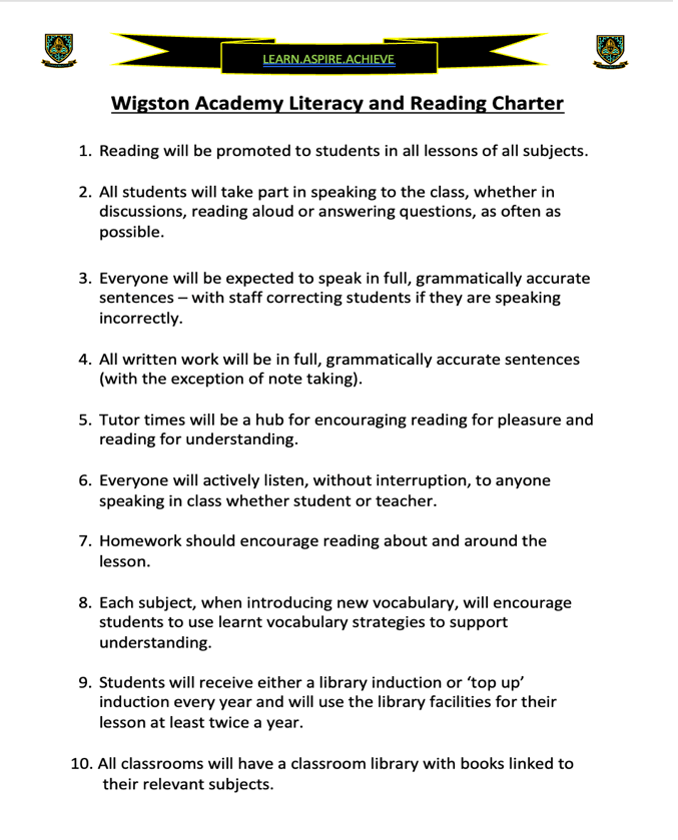
The premise was very simple: ten things which all teachers should have in their lessons to improve the literacy of their students. These charter items were put on a poster and placed in all classrooms throughout the school. It was then emailed to all staff with the instructions to go through it in their next department meetings (which was that week) and decide how their department was going to do it. Even as I am writing this I am shrinking back from the keyboard, wincing at the ridiculousness of what I was asking people to do and the timeline with which I was expecting things to be done. I even asked department heads to write a plan of how their department was going to embed the Literacy Charter into their domains!
However, after this I diligently went away and created the 10 things I thought all students should have in their lessons, I found a great way of presenting them in class, I sent them through to reprographics and had them all laminated. Once they came back, I walked around for an hour after school placing all the posters on walls in prominent places where they could be seen by students and patted myself on the back for a job well done. By this time the following term, all these things would be up and running and literacy levels throughout the school would skyrocket!
There’s a thing about rockets though, once they run out of fuel they come crashing to the ground. But I digress, I haven’t even given you the benefit of my genius: the literacy charter itself.
The charter had 10 things that all lessons should contain:
- Reading will be promoted to students in all lessons in all subjects.
- All students will take part in speaking to the class, whether in discussions, reading aloud or answering questions, as often as possible.
- Everyone will be expected to speak in full, grammatically accurate sentences – with staff correcting students if they are speaking incorrectly.
- All written work will be in full, grammatically accurate sentences (with the exception of note taking).
- Tutor times will be a hub for encouraging reading for pleasure and reading for understanding.
- Everyone will actively listen, without interruption, to anyone speaking in class whether student or teacher.
- Homework should encourage reading about and around the lesson.
- Each subject, when introducing new vocabulary, will encourage students to use learnt vocabulary strategies to support understanding.
- Students will receive either a library induction or ‘top up’ induction every year and will use the library facilities for their lesson at least twice a year.
- All classrooms will have a classroom library with books linked to their relevant subjects.
So not a lot to fit into all lessons, then?
After placing the posters in classrooms I sat back and waited…and waited…and waited. I went into a couple of lessons and sent a couple of feedback emails but as the weeks went on nothing was happening, nothing was changing and, as the year progressed, it faded into the wind. Even I lost the motivation to keep it going and pretty much lost any interest because no one was doing it and I couldn’t understand why! This was supposed to help behaviour, increase student’s access to the curriculum etc etc etc.
What I had failed to take into account, and you probably already know this, was that: I had introduced far too many things at once; I had given no notice or CPD to help implement the strategy; I had not followed up to see if things were happening in lessons; I hadn’t given the SLT who would be looking for it in lesson observations any CPD in what to look for… the list of reasons why it failed is a long one.
So what good came out of this utterly shambolic introduction of my first initiative? I learnt. I learnt that if you introduce too much too quickly then staff see it as just another addition to their workload and simply don’t do it. I learnt that if you don’t forewarn the staff they will simply not do it. If you don’t give them CPD about how to do it and why you are doing it, they won’t do it. I also learnt that if you don’t regularly check on the initiatives you have introduced then it will not be done.
It took a lot of energy and a lot of resolve to make the Literacy Charter, and as a bunch of things I would love to see in lessons it is something I was proud of. However, ultimately it was only good to teach me what not to do and how to do things differently.
Obviously, since then, the EEF have bought out their guide to implementation, which is amazing and also a great read from which I have learnt a lot. Now, through learning lessons and implementing other initiatives (some that have succeeded and some that have failed and taught me more lessons) I am beginning to make a difference to the students in my school and there are lots of amazing things embedded throughout the tutor times and through the curriculum.
So if I had my time again, would I do the same things again? Of course I would. Although the Literacy Charter ultimately failed, it taught me a lot and stopped me from making those same mistakes again.
The message then is simple: have a go.
If your initiative is over the top, do it; if your initiative is hard work, do it; if your initiative is doomed to failure, do it. No matter what, you will learn, and learning is the bedrock of everything!
Oh, and read the EEF guide to implementation!
Written by Sean Mackay
Literacy Coordinator at Wigston Academies Trust



 The Literacy Community
Leave a comment